

Can Spirits Communicate Through Mediums?
Explore how mediumship is believed to work, the role of evidential communication, and why this ancient practice continues to inspire curiosity, comfort, and debate around the world.
EVIDENTIAL MEDIUMSHIPSPIRIT ENERGYCONTINUATION OF LIFE
Donald Rumer-Rivera
7/14/20264 min read
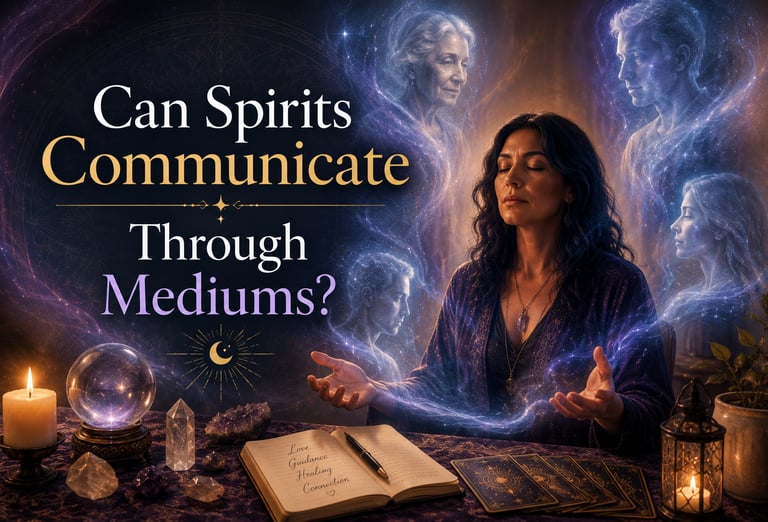
Can Spirits Communicate Through Mediums?
By Don Rumer-Rivera
Psychic Medium • Tarot Reader • Former Attorney • Engineer • Author
For as long as human beings have contemplated life after death, they have also wondered whether communication with those who have passed is possible. Across cultures, religions, and centuries, stories of spiritual encounters, signs from loved ones, and messages from beyond the physical world have been shared and debated. While opinions vary widely, one question continues to arise for those exploring spirituality and mediumship:
Can spirits communicate through mediums?
For many mediums and the people who seek their guidance, the answer is yes. However, understanding what that means—and what it does not mean—requires a closer look at how mediumship is believed to work.
At its core, mediumship is the practice of serving as a bridge between the physical world and the world of Spirit. A medium seeks to receive information, impressions, emotions, memories, and other forms of communication from those who have passed and to relay that information to the recipient in a meaningful and understandable way. Unlike psychic readings, which often focus on a person's life circumstances and future possibilities, mediumship specifically centers on communication with Spirit.
One of the most common misconceptions about mediumship is that communication occurs in the same way it does between two living people. Most mediums do not hear conversations as clearly as someone speaking across a table. Instead, communication is often described as a combination of impressions, feelings, images, thoughts, symbols, memories, and intuitive knowing. A medium may suddenly become aware of a particular personality trait, a meaningful memory, a physical characteristic, or a significant life event associated with the spirit communicator.
The challenge for the medium is not only receiving this information but also interpreting it accurately. Spirit communication is often compared to receiving pieces of a puzzle rather than a complete picture. As information is presented and validated, the broader message gradually emerges.
For many practitioners, one of the strongest arguments in favor of mediumship comes through evidential communication. Evidential mediumship focuses on providing information that can help identify the spirit communicator and validate the connection. This might include specific memories, personality traits, relationships, hobbies, life experiences, or details that hold significance for the recipient. The purpose is not simply to offer comfort but to provide evidence that supports the possibility that communication is taking place.
Those who have experienced a meaningful mediumship session often describe receiving information that the medium could not reasonably have known. Sometimes the details are deeply personal. Other times they may seem small or ordinary, yet carry tremendous significance for the person receiving them. These moments often become the foundation upon which trust in the communication is established.
Skeptics naturally ask important questions about mediumship, and those questions deserve thoughtful consideration. Could a medium be making educated guesses? Could the recipient be interpreting vague statements in a personal way? Could coincidence explain some experiences? These are valid questions, and responsible mediums generally welcome them. Healthy skepticism encourages higher standards, greater accountability, and a focus on evidence rather than assumption.
Many experienced mediums would agree that mediumship should not require blind belief. Instead, they encourage individuals to evaluate their own experiences and draw their own conclusions. The goal is not to convince someone that mediumship is real but to provide information that can be examined and considered honestly.
Another misconception is that mediums control Spirit communication. In reality, most practitioners describe the process as collaborative rather than controlled. A medium can create the conditions for communication and invite Spirit to participate, but they cannot force a particular spirit to appear or guarantee that a specific individual will communicate. Just as human conversations require participation from both parties, mediumistic communication is believed to involve cooperation between the medium and Spirit.
This is one reason why ethical mediums avoid making guarantees. While meaningful connections frequently occur, no responsible practitioner can promise exactly who will communicate or what information will be presented during a session.
For many people, the value of mediumship extends beyond evidence alone. A meaningful communication often provides reassurance, healing, understanding, or a renewed sense of connection. Individuals who have lost loved ones frequently seek comfort in knowing that relationships may continue beyond physical death. Others find peace in receiving messages that address unresolved emotions, unanswered questions, or shared memories.
It is important to recognize, however, that mediumship is not intended to replace the natural grieving process. Grief is a deeply personal journey that unfolds differently for each individual. While a mediumship session may offer comfort and perspective, it is not a substitute for emotional healing, counseling, or support from loved ones.
Many people are surprised to learn that signs from Spirit are not limited to formal mediumship sessions. Numerous individuals report experiencing meaningful coincidences, vivid dreams, familiar scents, songs appearing at significant moments, or a sudden sense of presence following the passing of a loved one. While interpretations vary, many view these experiences as possible forms of communication or connection from Spirit.
Mediums often describe their work as helping people recognize and understand forms of communication that may already be occurring around them. Rather than creating a connection where none exists, they seek to strengthen awareness of a connection that may already be present.
Ultimately, whether one believes that spirits can communicate through mediums is a deeply personal question. For some, the evidence provided through mediumship sessions is compelling and transformative. For others, skepticism remains. Both perspectives deserve respect.
What is clear is that mediumship occupies a unique place in the spiritual experiences of countless individuals around the world. It continues to inspire curiosity, comfort, debate, and exploration because it touches upon one of humanity's most profound questions: What happens after we die?
For those who have experienced a meaningful connection through a medium, the question often shifts. Rather than asking whether communication is possible, they begin asking how they can better understand the relationship between the physical world and the world of Spirit.
Whether viewed as a spiritual practice, a source of comfort, or an area of personal exploration, mediumship invites us to consider the possibility that love, connection, and consciousness may extend beyond the boundaries of physical life. And for many, that possibility alone is worth exploring.
About the author -- Don Rumer-Rivera has spent decades studying the relationship between intuition, energy, and spiritual communication through both professional practice and independent research. A former engineer and attorney, he brings an analytical, evidence-based approach to tarot and psychic readings, combining careful observation with thousands of client sessions. He is the author of The Ultimate Power Within: Unleashing the Magic of Affirmations, which explores how people continually project energy into the world around them while also receiving energy from the people, places, and environments they encounter.